
Most companies don’t break because of bad people.
They break because no one is quite sure how decisions are actually made.
This first Peace Seal master class introduces a practical concept many organizations overlook: governance. Not governance as legal paperwork or compliance language, but governance as it shows up every day. Who decides. Who is consulted. Who is affected. And what happens when that structure is unclear.
When companies understand how power moves internally, they reduce internal conflict, lower legal and reputational risk, and make leadership far easier. When they don’t, even the best values struggle to survive under pressure.
Governance is not about control. It is about clarity.
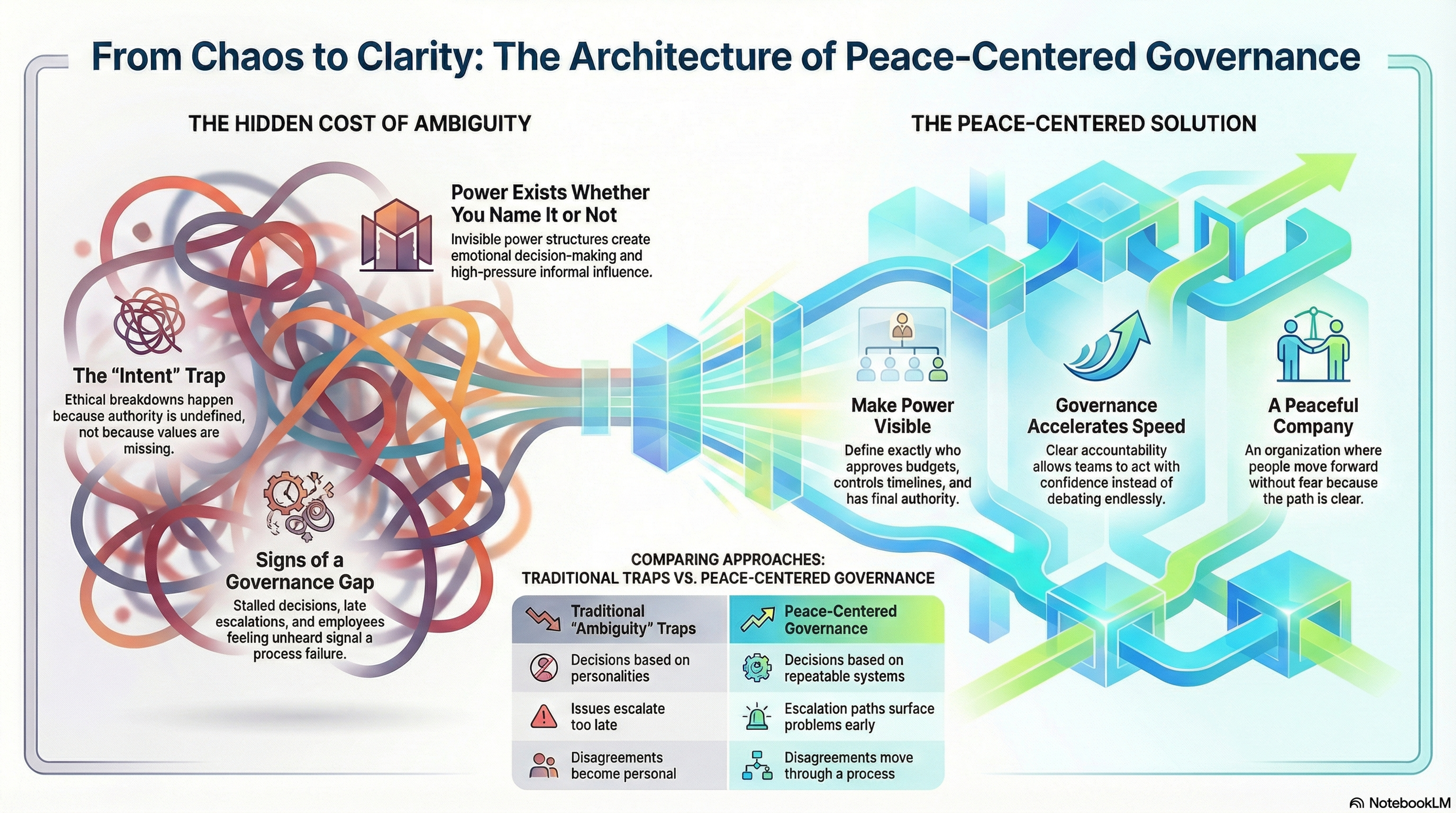
Across industries, organizational research consistently shows that internal breakdowns are rarely caused by unethical intent. They happen because authority is informal, undocumented, or dependent on personalities. A 2023 Deloitte study on organizational risk found that governance ambiguity is one of the top predictors of internal conflict escalation and delayed decision-making, even in companies with strong stated values.
Every organization has power structures, whether they are written down or not. Power appears in who approves budgets, who sets timelines, who can override decisions, and whose voice carries weight when priorities collide. When that power is unnamed, it becomes invisible. When it is invisible, it becomes risky.
Invisible power forces decisions to happen informally. People negotiate outcomes in side conversations. Issues get resolved emotionally or under time pressure. Concerns surface late, often when the cost of correction is already high.
This is where internal conflict grows. Not because people disagree, but because they don’t know how disagreement is supposed to move forward safely.
When decision authority is clear, teams act with confidence instead of hesitation. When escalation paths are defined, problems surface early instead of exploding later. When accountability is documented, leaders are no longer pulled into every issue by default.
Research from MIT Sloan has shown that organizations with clearly documented decision rights experience faster execution, lower employee turnover, and higher trust between leadership and staff. Employees report feeling more respected when they understand how decisions are made, even if they don’t always agree with the outcome.
This is why peace-centered governance reduces chaos.
Most workplace stress comes from ambiguity. Ambiguous authority leads to duplicated work. Ambiguous accountability leads to blame. Ambiguous responsibility leads to silence.
A simple way to recognize whether governance is unclear is to think about the last difficult decision your company made. Not whether the outcome was good or bad, but how the decision unfolded.
Was it clear who had final authority from the start?
Was input gathered intentionally or only after conflict appeared?
Did anyone feel blindsided once the decision was announced?
If the process felt tense, rushed, or emotionally charged, there is a governance problem.
Peace-centered governance starts by tightening the process before pressure hits.
This is why the Peace Seal does not measure intent. It measures systems.
The Peace Seal framework evaluates whether decision-making structures are visible, documented, and fair. It looks at how power is distributed, how concerns are raised, and how accountability is enforced when values are tested.
This first class is foundational. Without clear governance, everything else becomes harder.
A peaceful company is one where power is visible, decisions are clear, and people know how to move forward without fear.
That is where peace-centered leadership begins.
Founding businesses receive free access to the Peace Seal certification process, advisory support to help reach a minimum 70 score, and inclusion in the Peace Seal Directory as a verified ethical workplace. Founders also receive long-term recognition, priority visibility, and access to the full Peace Seal Master Class series designed for leadership teams.
Apply now to download the Peace Governance Blueprint Pack and secure your place as a Peace Seal Founder:
https://pledge4peace.org/articles/peace-seal-founders
Continue with Class 2 - The Trust Engine: Turning Culture Into a Performance Asset: https://pledge4peace.org/articles/Turning-Culture-Into-a-Performance-Asset
